


Passive House Block Walls

Overview
Page 01 / 03Passive House Block should not be presented as another masonry unit. It is a wall system where structure, insulation thickness and construction speed are designed to work together.
The most important message is simple: the wall is not evaluated only by the price of one square metre of material. In a real project, the cost and performance of the shell include foundation logic, wall thickness, reinforcement, thermal bridges, airtightness, facade strategy, construction speed and the engineering systems that become smaller when the envelope performs well. This is why the Passive House Block story should always compare complete shell logic, not isolated products on a shelf.
What the block solves
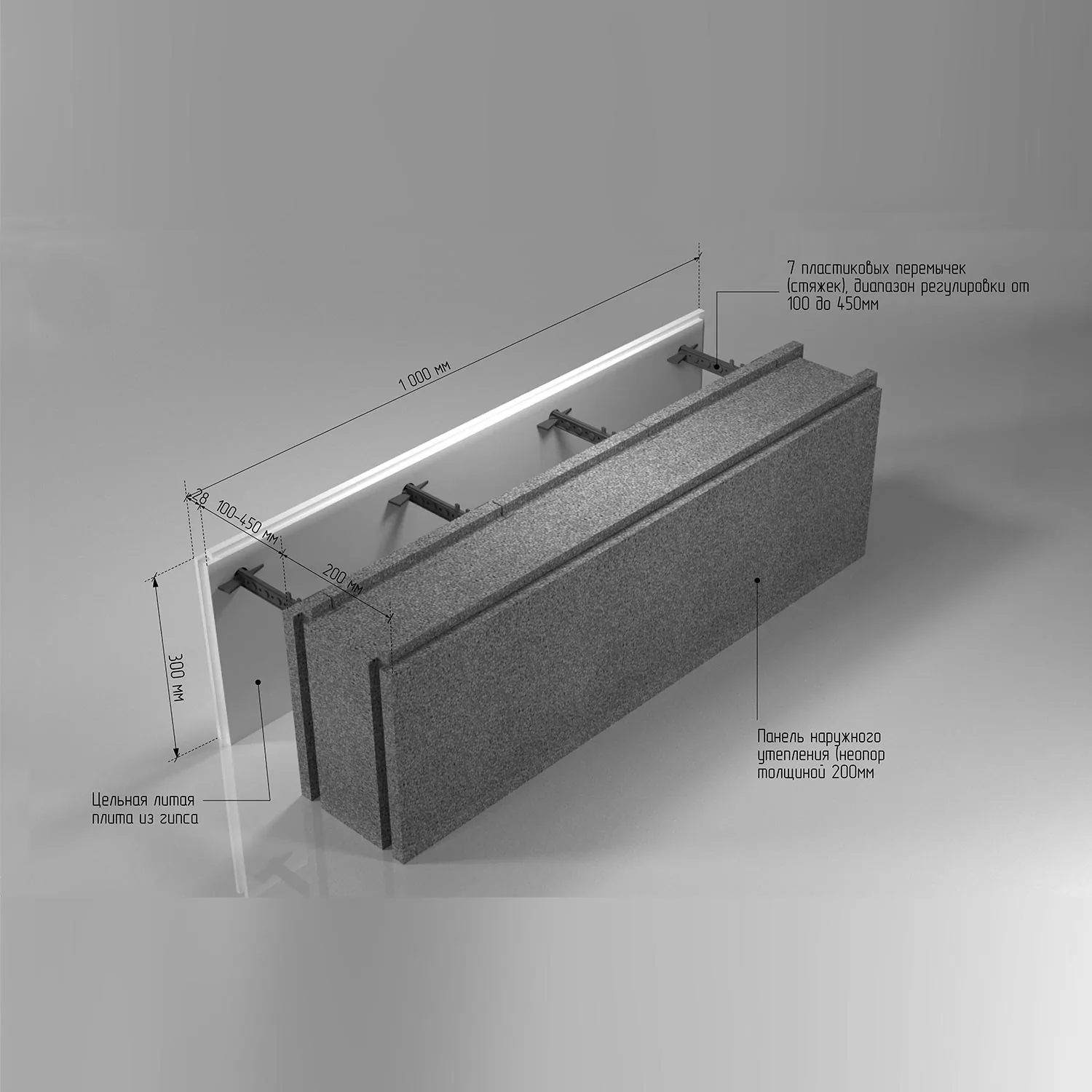
Traditional wall systems often separate structure, insulation and facade into several layers built by different teams. Passive House Block reduces that fragmentation: the wall is built as an insulated formwork system with reinforced concrete inside and exterior insulation where the thermal layer belongs.
Why exterior insulation matters
Keeping insulation on the outside helps the concrete core remain inside the thermal zone. That gives the building more temperature stability, improves summer and winter comfort and protects the mass from fast outdoor temperature swings.
Wall Options
Page 02 / 03The product group should be easy to scan: Energy+, NZEB, NZEB+ and Passive House Block as four performance tiers based on insulation thickness.
Energy+ / 150 mm
A compact high-performance option for buildings where wall thickness, budget and strong thermal improvement need to stay balanced.
NZEB / 200 mm
A practical near-zero-energy-oriented tier for clients who want a serious envelope without moving immediately into the maximum thickness configuration.
NZEB+ / 250 mm
A stronger option for colder climates, lower heating demand or projects that need performance close to passive-house component benchmarks.
Passive House / 300 mm
The flagship wall configuration, positioned for passive-house-oriented envelopes and resilient long-term operation.
The values above are calculated as indicative insulation-layer values using graphite EPS / Neopor λ = 0.032 W/m·K. Final wall U-value must include the complete wall build-up, concrete, finishes, geometry, junctions and thermal bridges.
Comparison Logic
Page 03 / 03The correct comparison is not “block versus block.” It is “complete shell versus complete shell.”
Against brick
Brick can be familiar and robust, but reaching very low U-values usually requires a separate insulation layer, careful anchoring, facade decisions and thermal-bridge control. The wall becomes a multi-trade assembly rather than a single coordinated system.
Against gas block
Gas block can be economical and light, but the final shell still depends on external insulation, structural strategy, airtightness and proper junctions. The simple material price does not describe the complete result.
Against SIP
SIP can be very fast and cost-competitive, but the value proposition is different: lightweight panels, different fire/acoustic/repair logic and different long-term mass behavior. Passive House Block speaks to clients who want insulated concrete mass and resilience.
Against frame
Frame construction can be efficient when executed well, but performance depends heavily on workmanship, membranes, penetrations and detailing. Passive House Block should be positioned as a more massive, structurally resilient envelope system.
Source notes
These article pages are written as publishing-ready technical content, not as certification claims. Final values must be verified by the project engineer, local code calculation, wall build-up, thermal-bridge model and site testing.




More Tech Lab articles.
 Dew Point Explained
Condensation risk, wet insulation behaviour and why internal wall insulation needs special care.
Read article
Dew Point Explained
Condensation risk, wet insulation behaviour and why internal wall insulation needs special care.
Read article
 Continuous Thermal Envelope
How insulation, airtightness and thermal-bridge control stay continuous around the building.
Read article
Continuous Thermal Envelope
How insulation, airtightness and thermal-bridge control stay continuous around the building.
Read article
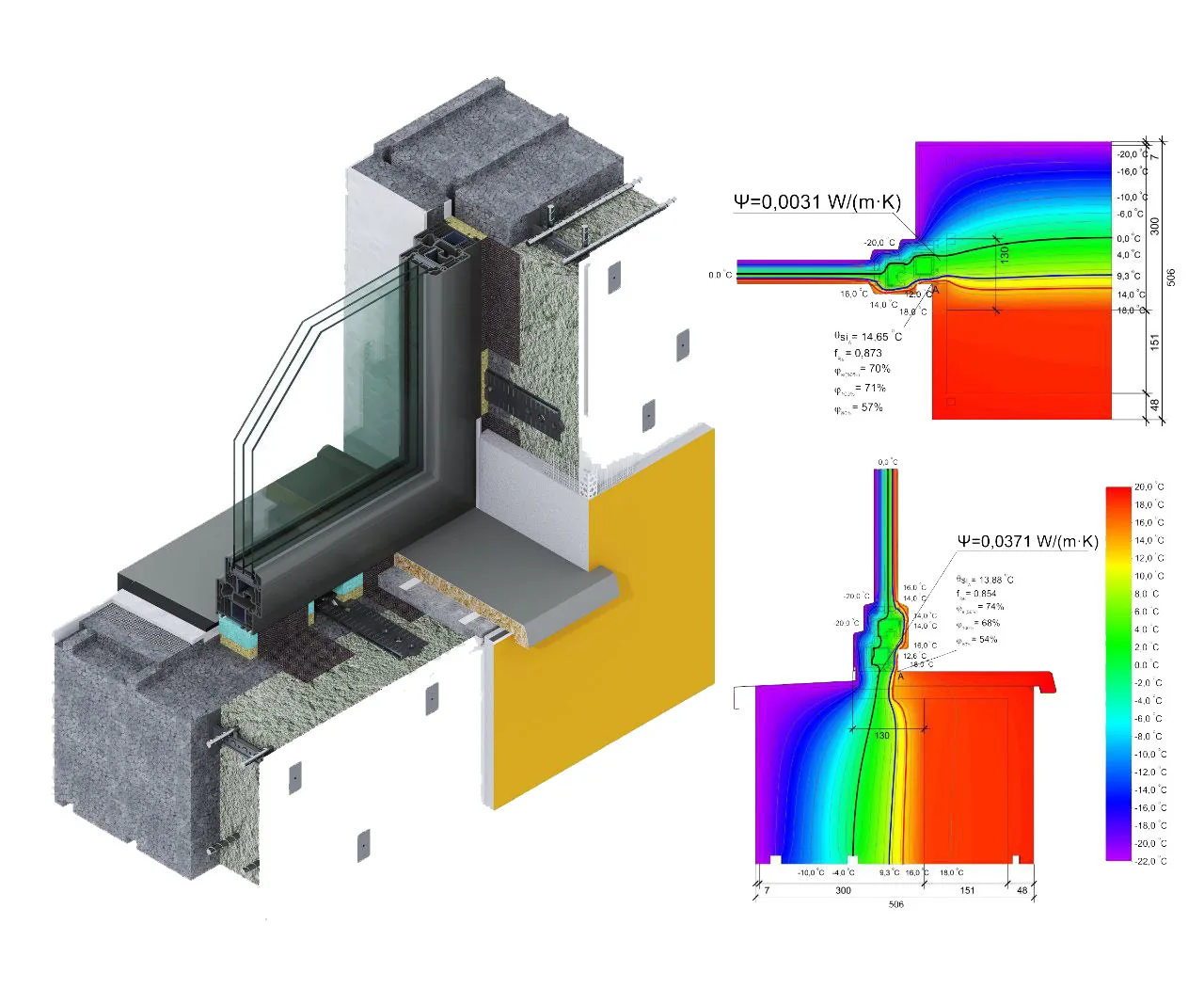 Warm Window & Door Installation
Installation detail for frames, insulation-line connection and airtight-layer sealing.
Read article
Warm Window & Door Installation
Installation detail for frames, insulation-line connection and airtight-layer sealing.
Read article