


Continuous Thermal Envelope
Overview
Page 01 / 03The thermal envelope is the invisible line that decides whether the building performs as designed or simply looks efficient in drawings.
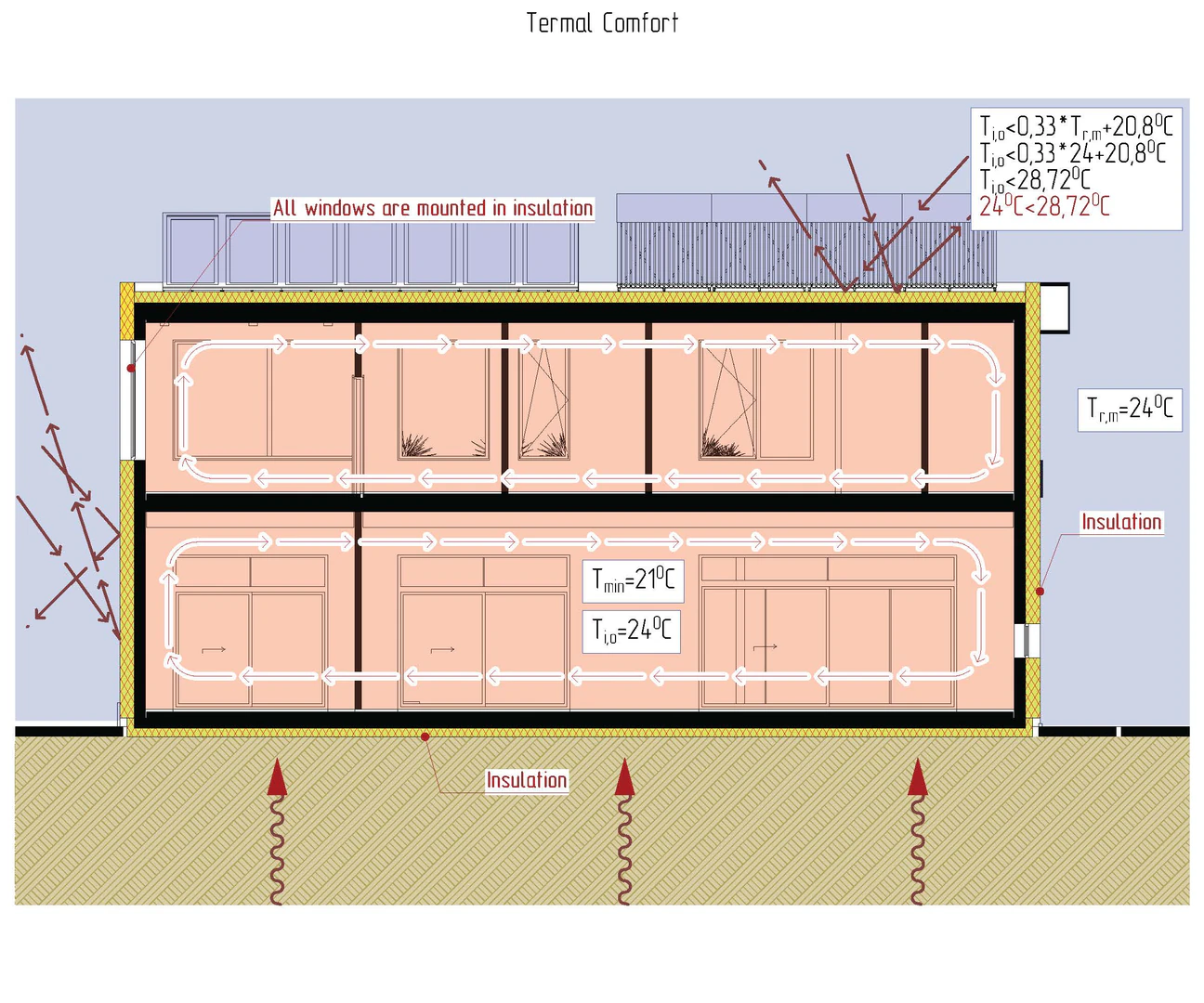
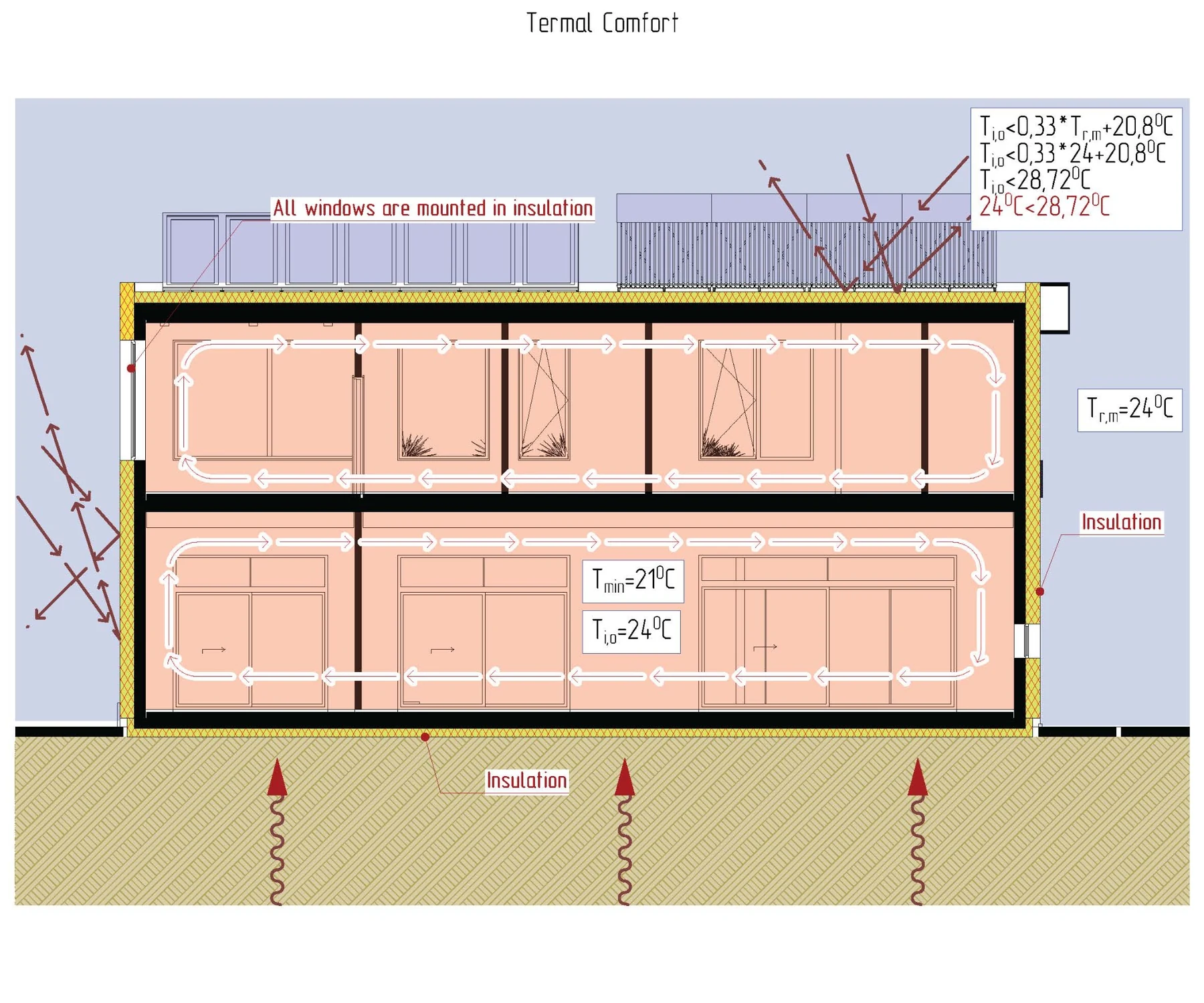
The wall system is central, but it is not the whole story. A passive-house-oriented building works when the insulation line, airtight line and structural line are intentionally coordinated around the whole building. The envelope includes walls, roof, foundation, openings, service penetrations, balcony or canopy details, facade connections and installation sequences. The result is not created by one expensive component; it is created by continuity.
Thermal continuity
Insulation should form a continuous protective layer around the heated volume. Every interruption is a potential thermal bridge: a place where heat moves faster, surface temperatures drop and condensation risk can increase.
Airtight continuity
Airtightness is not the same as insulation. It is the control of uncontrolled air leakage. Without it, warm indoor air can escape through cracks and junctions even when insulation thickness looks impressive.
Airtightness
Page 02 / 03Airtightness is the difference between theoretical insulation and real comfort.
A building can have a strong wall build-up and still lose energy through leakage. Air leakage also carries moisture, which can move into assemblies and create hidden long-term risk. This is why airtightness should be explained to clients not as an abstract Passive House obsession, but as basic reliability: the building must control where air enters and leaves. Ventilation should be intentional, filtered and heat-recovered, not accidental through cracks.
Why n50 matters
The n50 value describes air changes per hour at a 50 Pa pressure difference during a blower-door test. It is a site test, not a brochure number. For Passive House certification logic, n50 ≤ 0.6 h⁻¹ is a widely recognized maximum target; better results require consistent detailing and site discipline.
Internal PHB proof logic
The project source text records measured airtightness examples around 0.14–0.15 for commercial and residential buildings. These are very strong proof points, but they should be published only when the matching blower-door protocol, building type and test conditions are available.
Why equipment depends on it
Heat recovery ventilation only makes technical sense when the envelope is tight enough. If leakage dominates air exchange, expensive ventilation equipment loses part of its purpose because air bypasses the heat exchanger.
Why users care
Airtight buildings feel calmer: fewer draughts, more stable temperatures, less dust infiltration and better control over humidity. This comfort is often easier for clients to understand than a technical leakage number.
Envelope Checklist
Page 03 / 03A clear envelope checklist turns an abstract energy target into construction logic.
Good website wording
“Passive House Block provides the wall system; the complete passive-house result comes from a continuous envelope: insulated base, monolithic insulated walls, warm openings, airtightness and low-demand building systems.”
Bad website wording
“This wall alone guarantees a passive house.” That is too risky. Passive House performance is a whole-building result and must be verified through project-specific energy modelling and site testing.
Source notes
These article pages are written as publishing-ready technical content, not as certification claims. Final values must be verified by the project engineer, local code calculation, wall build-up, thermal-bridge model and site testing.
More Tech Lab articles.
 Dew Point Explained
Condensation risk, wet insulation behaviour and why internal wall insulation needs special care.
Read article
Dew Point Explained
Condensation risk, wet insulation behaviour and why internal wall insulation needs special care.
Read article
 Passive House Block Walls
Exterior insulation, reinforced concrete core and the build logic behind the main wall system.
Read article
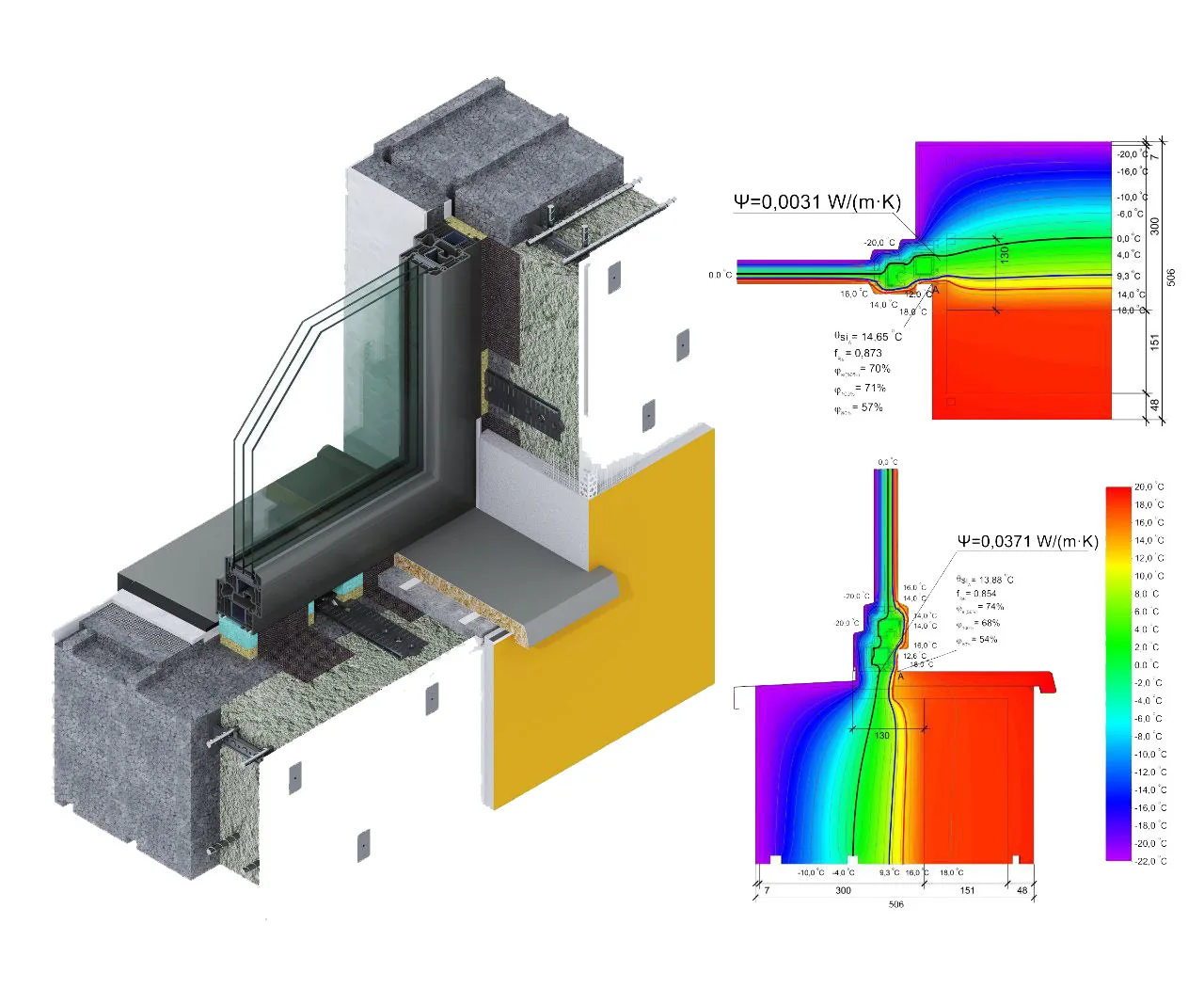
Warm Window & Door Installation
Installation detail for frames, insulation-line connection and airtight-layer sealing.
Read article
Passive House Block Walls
Exterior insulation, reinforced concrete core and the build logic behind the main wall system.
Read article
Warm Window & Door Installation
Installation detail for frames, insulation-line connection and airtight-layer sealing.
Read article