

Answer-first summary
Warm window installation means the window is treated as part of the thermal envelope, not as a cold insert fixed only to the edge of the load-bearing wall. In a Passive House Block wall, the strongest detail is to move the frame outward into the continuous exterior insulation layer, so the reinforced concrete remains on the warm side and the opening does not become a thermal bridge.
Key takeaways
- The frame should align with the insulation plane whenever the wall system and structural calculation allow it.
- The load path must be solved with brackets, consoles or a dedicated support profile, not with foam alone.
- Airtightness, water protection and vapor control are separate layers; each must stay continuous around the opening.
- The goal is not only a warmer window, but a cleaner wall system with fewer weak edges.
Why the structural-wall edge is a weak place
When a high-performance window is installed directly on the face of a concrete or masonry bearing wall, the frame often sits outside the best thermal line. The insulation then has to wrap back around the reveal, and the window perimeter becomes the place where heat flow concentrates. This can lower interior surface temperature around the frame, increase condensation risk and reduce the real value of an otherwise strong wall assembly.
Passive House Block is based on the opposite logic: the structural concrete is inside the warm mass of the building, and the insulation is outside. Window installation should respect that same physics. The window should be placed where the insulation can continue past the frame with minimal interruption.
What changes when the window moves outward
Moving the window into the insulation contour changes the detail from a simple frame-in-wall operation into a small structural node. The window still needs reliable mechanical support for its weight, wind load, operating forces and long-term movement. That support can come from engineered brackets, console systems, warm support profiles or a project-specific frame fixed back to the structure.
The public VSThermo reference is useful because it separates two important ideas: a warm support profile under the window and console systems for installing windows in the insulation zone. For Passive House Block, the exact product may change by country and supplier, but the design principle is the same: carry the window safely while avoiding a metal or concrete path that cuts through the insulation line.
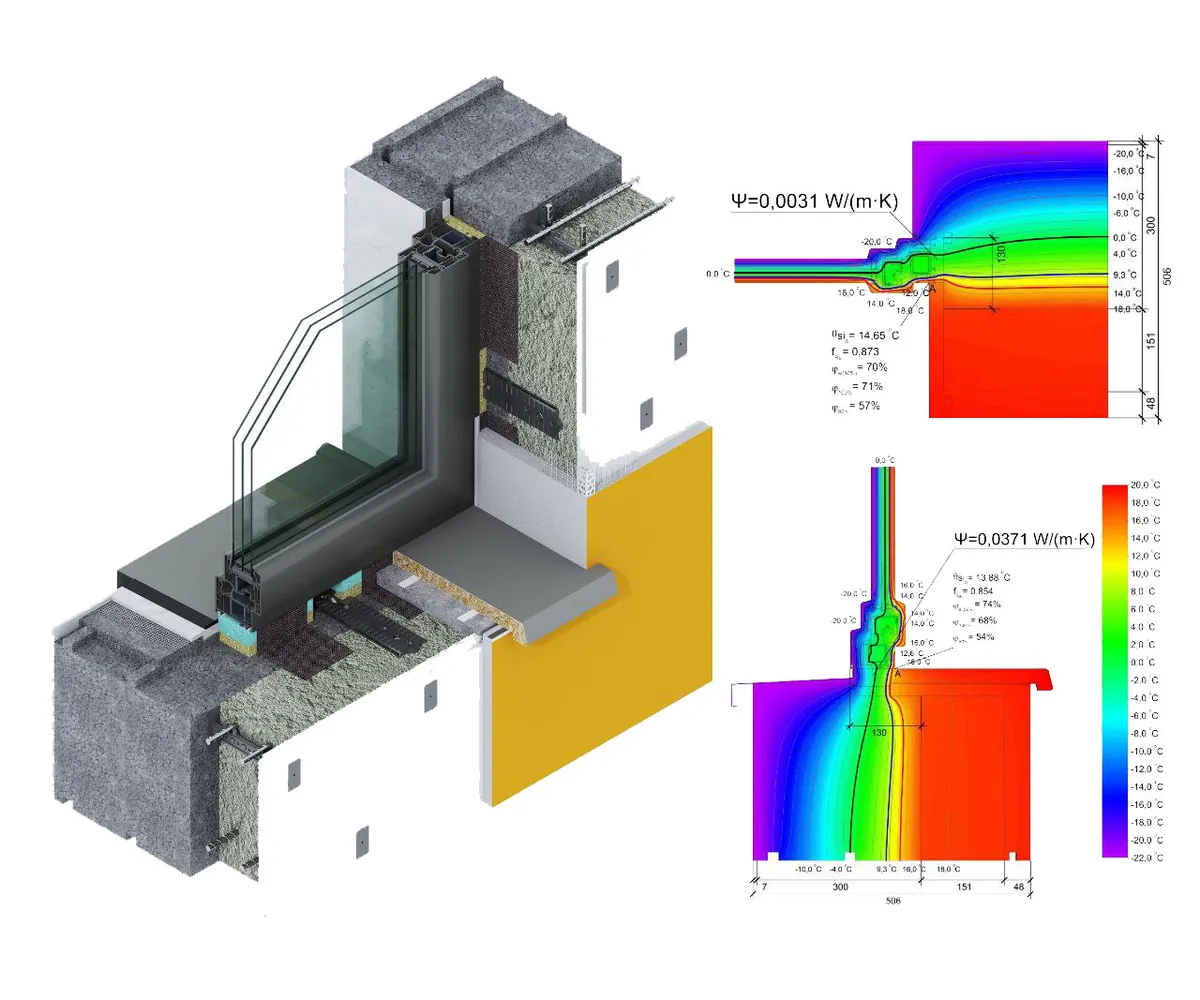
Pre-wall frame system VST80x90
The pointer highlights the profile set named by VSThermo for window installation: VST 80x90 pre-wall frame profiles, a vapour-permeable outer tape or sealant, hybrid polymer bond and warm base profiles under the sill.
Source: VSThermo VST 80x90 system- 01VST 80x90 pre-wall frame carries the frame in front of the structural wall.
- 02Outer seal uses vapour-permeable tape or sealant to protect the exposed joint.
- 03Hybrid polymer bond joins the support profile and keeps the load path continuous.
- 04Warm base profiles support the sill without cutting through the insulation line.
Layer sequence around the opening
A good warm-installation detail has three continuous layers. The inner layer is airtight and connects the window frame to the interior air barrier. The middle layer controls movement and insulation around the joint. The outer layer handles wind-driven rain and weather exposure while allowing the assembly to dry in the correct direction. If one of these layers is missing, the thermal detail may look correct in section but fail in real use.
This is why the window node should be drawn before construction starts. The architect, structural engineer and installer need one shared section showing the frame position, support bracket, insulation return, sill slope, tapes or membranes, plaster/facade termination and drainage path.
How this fits Passive House Block
For Passive House Block, warm window installation is part of the same implementation cluster as exterior insulation, thermal mass and airtight envelope design. The wall can deliver its full value only if openings are handled with the same discipline as the wall field. A thick insulation layer and a reinforced concrete core do not automatically create a passive-house-grade envelope if windows are left as unmanaged bridges.
Related technical pages should connect this article to the Passive House Block product system, the Tech Lab and future detail pages for foundation, roof and door thresholds. The practical next step is a small library of section drawings for typical window positions, sill details and balcony-door thresholds.
Draft specification note
For now, the working specification is simple: place the frame in the insulation layer where possible, verify the bracket/support system structurally, keep the air barrier continuous, and avoid hard thermal bridges through metal, concrete or mortar at the reveal. The final product choice should be adapted to local certification, installer experience and climate exposure.
Source note
This draft uses the public VSThermo product page as a technical reference for warm support profiles, VST80x90 pre-wall frame installation and console-based window positioning in the insulation zone. The article is written as Passive House Block In Practice guidance, not as a copy of that source.
Frequently asked questions
Short answers before detailing a warm window installation.
Why move the frame into the insulation layer?
The frame is warmer when it sits in the insulation plane. This reduces heat concentration around the reveal and helps keep the reinforced concrete core on the warm side of the envelope.
Can installation foam carry the window?
No. Foam can insulate and fill the joint, but the window still needs a verified mechanical support path for weight, wind load, operating forces and long-term movement.
Which layers must stay continuous around the opening?
The inner airtight layer, the middle insulation and movement layer, and the outer weather-protection layer all need a continuous path around the frame.

Other In Practice articles.
 The House That Protected a Family During War
A Bucha client story about how an all-electric passive-level family house stayed livable for about a winter month without power, active heating or reliable communication.
Read article
The House That Protected a Family During War
A Bucha client story about how an all-electric passive-level family house stayed livable for about a winter month without power, active heating or reliable communication.
Read article
 Two-side insulated strip foundation
A practical ICF detail where the concrete strip foundation is formed inside permanent insulation, reducing site work while keeping the thermal envelope continuous.
Read article
Two-side insulated strip foundation
A practical ICF detail where the concrete strip foundation is formed inside permanent insulation, reducing site work while keeping the thermal envelope continuous.
Read article
 Insulated Swedish Slab Foundation: UShP as a Warm Base for Passive Houses
How an insulated Swedish slab combines a shallow reinforced concrete foundation, continuous insulation, built-in services and warm-floor heating into one high-performance base.
Read article
Insulated Swedish Slab Foundation: UShP as a Warm Base for Passive Houses
How an insulated Swedish slab combines a shallow reinforced concrete foundation, continuous insulation, built-in services and warm-floor heating into one high-performance base.
Read article